
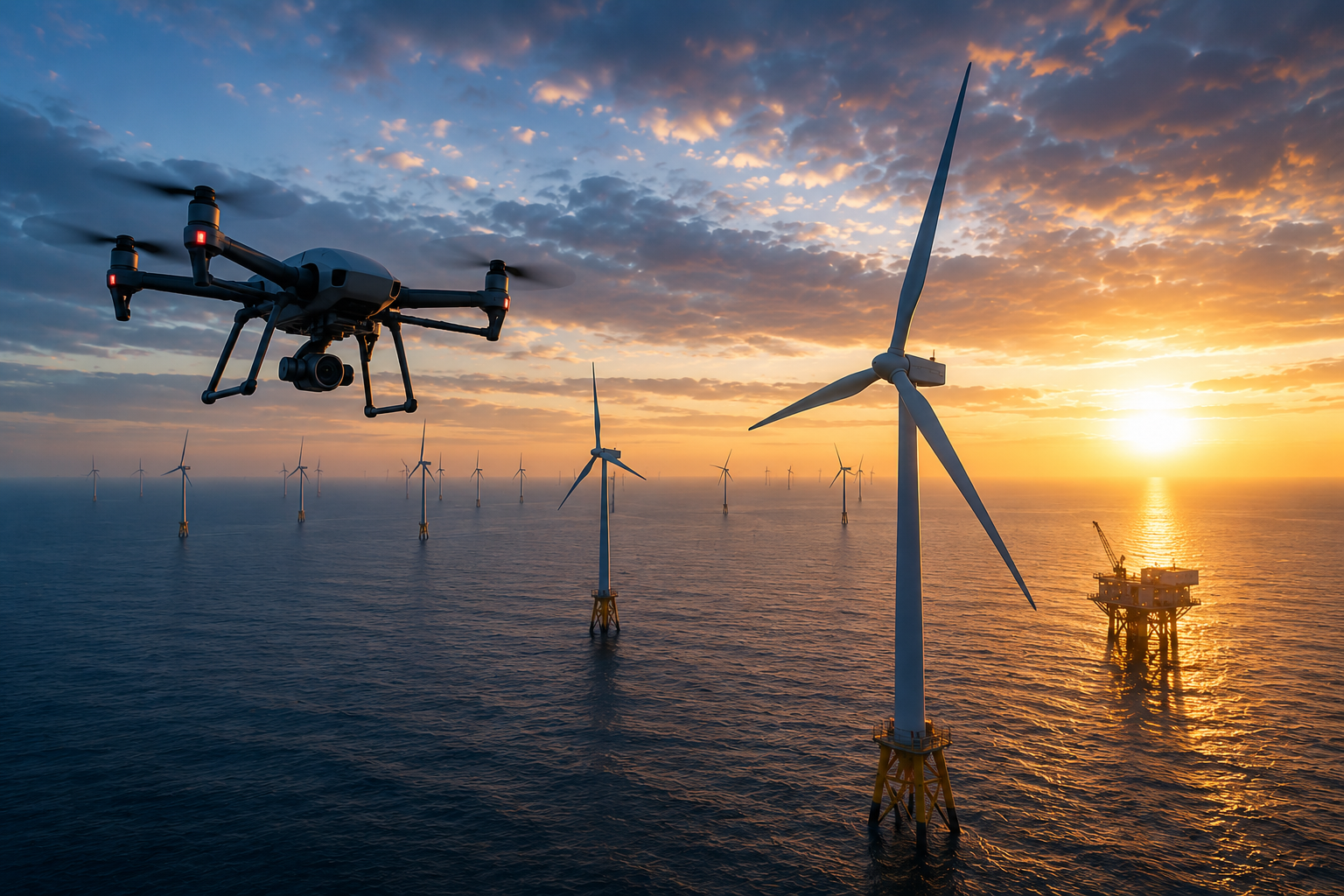
Offshore wind energy: drone operations over turbines and platforms at sea
OFFSHORE WIND & ENERGY

Drone Operations for Offshore Wind & Energy Infrastructure

Dronecloud helps offshore energy operators scale drone inspections, coordinate operational airspace, support BVLOS workflows, and maintain operational oversight across remote offshore infrastructure environments.
  • BVLOS Offshore Operations
  • Wind Turbine Inspections
  • Maritime Airspace Coordination
  • Conformance Monitoring
  • Operational Oversight
  • Enterprise Flight Management

Why BVLOS Matters for Offshore Infrastructure

Long-Range Operational Visibility at Scale

BVLOS operations significantly improve the scalability and efficiency of offshore infrastructure inspections by supporting larger operational areas, reducing deployment complexity, and improving operational visibility across remote infrastructure environments.

However, scalable offshore BVLOS operations require operational infrastructure capable of maintaining situational awareness, coordinating airspace usage, monitoring telemetry, and supporting operational governance at scale.

Managing Remote Offshore Infrastructure at Scale

Offshore wind farms and maritime energy infrastructure environments are geographically distributed, operationally complex, and difficult to access using traditional inspection workflows.

Operators must maintain visibility of infrastructure conditions, support maintenance planning, manage operational risk, and coordinate multi-asset activity and airspace coordination across remote offshore operational environments.

As offshore drone programmes mature, organisations increasingly require operational infrastructure capable of supporting scalable BVLOS workflows, telemetry oversight, operational awareness, and connected operational coordination for offshore drone inspections and wind turbine inspections.

Coverage

Drone Operations Across Offshore Infrastructure

Enterprise offshore drone operations span turbines, offshore platforms, maritime operational zones, and coastal infrastructure — requiring consistent visibility, coordination, and governance across geographically distributed assets.

Wind Turbine Inspections

Inspect offshore wind turbines, blades, towers, and supporting infrastructure while reducing operational disruption and improving infrastructure visibility.

Offshore Platform Monitoring

Support operational awareness and infrastructure inspections across offshore operational platforms and distributed maritime infrastructure.

Maritime Operational Awareness

Coordinate operational visibility across offshore environments, vessels, infrastructure zones, and dynamic operational conditions.

Environmental & Coastal Monitoring

Support environmental inspections, marine monitoring, coastal awareness, and operational risk visibility across offshore operational environments.

Build scalable drone operations across offshore infrastructure

Connect flight planning, telemetry, UTM coordination and operational governance for offshore wind and maritime infrastructure programmes.

Operational focus

Offshore assets
Supporting context

Structure programmes around turbines, platforms, and distributed maritime infrastructure.

Maritime coordination
Supporting context

Align flight intent with vessels, zones, and shared operational context offshore.

BVLOS readiness
Supporting context

Build the workflows, telemetry visibility, and governance expected for long-range programmes.

Operational evidence
Supporting context

Keep approvals, telemetry history, and inspection records in a coherent audit trail.

Telemetry visibility
Supporting context

Maintain live aircraft state alongside environmental and operational events.

Process

Offshore Operations Journey

  1. Plan

    Mission design, maritime constraints, offshore asset zones

  2. Coordinate

    Airspace awareness, vessel activity, operational intent

  3. Monitor

    Telemetry, aircraft status, offshore weather and live events

  4. Evidence

    Audit trail, reports, inspection records and operational review

  5. Scale

    Repeatable workflows for offshore wind programmes

Contrast

Why Offshore Is Different

Offshore wind and maritime energy programmes introduce constraints that rarely appear in routine, short-range drone deployments.

Standard drone operations compared to Offshore infrastructure operations
Operating environment
Standard drone operationsLand-based sites, predictable access, and shorter transit between staging areas.
Offshore infrastructure operationsRemote sea states, vessel-dependent access, and infrastructure distributed across maritime zones.
Connectivity
Standard drone operationsTypically stronger ground links and simpler relay paths for command and control.
Offshore infrastructure operationsStretched RF paths, satellite or mesh dependencies, and higher sensitivity to link loss.
Weather exposure
Standard drone operationsLocal wind and precipitation with more options to delay or reposition quickly.
Offshore infrastructure operationsMarine weather, sea spray, gust variability, and fewer immediate diversion options offshore.
Asset complexity
Standard drone operationsSingle-site or short-range missions with relatively contained airspace risk.
Offshore infrastructure operationsTurbines, substations, cables, and platform layouts that demand structured asset zoning and repeatable inspections.
Operational evidence
Standard drone operationsDisconnected logs and artefacts unless programmes enforce a single system of record.
Offshore infrastructure operationsInspection records, approvals, telemetry history, and audit-ready evidence expected across programmes.
Airspace / maritime coordination
Standard drone operationsPrimarily aviation coordination with limited maritime stakeholder overlap.
Offshore infrastructure operationsCombined airspace and maritime intent — vessels, restricted zones, notices, and a shared operational picture.

Integrated Flight Management and UTM for Offshore Infrastructure

Dronecloud connects flight management, UTM, telemetry oversight, and airspace coordination for offshore wind programmes, maritime operations, and infrastructure-scale offshore drone inspections — supporting scalable BVLOS inspections, maritime operational coordination, conformance monitoring, operational airspace awareness, programme oversight, and API-first integration with your existing operational stack.

Explore BVLOS drone operations, the UTM platform, airspace management, and the core platform. Review the BVLOS readiness checklist and What is UTM? for programme context; see Ports & Maritime and Energy & Utilities for adjacent infrastructure operations.

Platform fit

Built for Operationally Complex Offshore Environments

Dronecloud combines flight management, telemetry oversight, operational coordination, maritime airspace awareness, and UTM capabilities into a connected operational platform designed for infrastructure-scale offshore drone ecosystems. Contact the team to discuss offshore energy programmes, or continue with BVLOS operations, UTM, airspace management, and the platform overview.

Maturity

From Pilot Projects to Scalable Offshore Ecosystems

A progression from localised offshore activity to enterprise-scale BVLOS offshore operations and integrated maritime coordination.
Stage 1

Localised Offshore Operations

Small-scale inspections using isolated workflows and limited operational coordination.

Stage 2

Digitised Operational Coordination

Connected mission planning, telemetry visibility, operational records, and workflow management.

Stage 3

Multi-Site Offshore Operations

Shared situational awareness, operational coordination, and telemetry oversight across distributed offshore environments.

Stage 4

Scalable BVLOS Offshore Ecosystems

Integrated airspace management, telemetry oversight, operational coordination, and enterprise-scale offshore drone operations.

Moving Beyond Localised Drone Deployments

As offshore drone operations scale, organisations require operational systems capable of supporting coordinated, repeatable, and auditable activity across large maritime environments — from BVLOS operational coordination, maritime airspace awareness, and conformance monitoring to telemetry oversight, multi-aircraft visibility, operational governance, infrastructure-scale situational awareness, approvals and workflows, risk assessment coordination, and enterprise oversight.

Dronecloud helps offshore operators transition from isolated drone deployments toward connected and scalable offshore operational ecosystems.

Build scalable drone operations across offshore infrastructure

Connect flight planning, telemetry, UTM coordination and operational governance for offshore wind and maritime infrastructure programmes.